Mine has been a life of much certainty.
I could argue that the script of most lives can be predicted to a fair degree, owing to the fact that being unremarkable is common to them all, still, that is more so because of their inability to do otherwise than intention. There’s no denying that change is uncomfortable for everyone but this “sickness” that I’ve caught - whereof I don’t know - is not normal.
Most days I can predict where I will be and what I would be doing with almost perfect certainty. Any little deviations from that prediction too are accounted within an error margin of possibilities. And there’s nothing peculiar about it, yet, for I like many others do live a pretty monotonous life.
Each of my days are same, down to the minute and honestly, I derive a quite a bit of comfort in them being so. Arrival of any new event, clouded by uncertainty around it brings tenfold as much anxiety to me than is should. Most would resonate to some degree but I’ve realised that within me, it’s a bit more aberrant - more than just a “bit”.
Picture lunch time, people excited to try out that new dish on the menu. I could try it out too, right? Rationally something as trifling as this should not even register as a “decision” to be made and yet I would be there trying to force myself, to atleast, at the very least and for my own sanity, walk up to the counter and order it. This cannot be and should not be that hard, and yet I freeze. My hands won’t move, as if my consciousness itself is forbidding me from this great sin, perhapss the greatest of sins for that moment - to order something that I did not order yesterday, and the day before, and before that as well, for the past 2 years…
Maybe it would’ve been easier if I could not justify it to me. But I believe all my lies in that moment, about tge price being too high or the taste to price ratio not being worth it or of the dish being overrated ( despite never having tried it! ). It becomes such a mental strain that giving up is all I’ve done, which is fine since it’s just lunch - but it never was just that.
The taste could never be that bad, and the price too was within reason. Something that required an interaction with another person could be explained by social anxiety but that’s only part of the problem since this symptom is not isolated to only those cases. Why did I even need to think so much about it? Such fear of uncertainty has taken root in me…
Uncertainty over how the interaction to order would go, uncertainty over the taste of it, uncertainty over the fulfillment I’ll eventually derive from it, so much uncertainty. It might not be a big deal to someone else but to me it’s a deviation from my ritual which destiny must force upon me while I try what I can to resist it. It did not have to be so, I know of my social anxiety but this is unexplainable. The same goes for paths I travel ( literally ), what time I go for lunch ( if I could not make it on time there’s a high chance I would skip lunch altogether ), going to a new restaurant - anythin and everything. The common denominator is “uncertainty”. If I cannot predict it and predict the outcome along with the possible deviations in its entirety, then there is a very high mental cost of the action, one which I don’t try to bother with at all.
Is it all simply a “paradox of choice”? No, I cannot quite justify it by that, for most often there is no “choice overload” involved and thanks to online shopping, I can recognise when that is the case.
For a very very long time, I considered this behavior to be abnormal. Abnormal simply because anyone else would consider it so. But I don’t quite think so anymore.
Why should my approach be wrong at all? It’s not like there is no rational basis for it - what I called “lies” earlier weren’t all that untrue. Why must I choose differently after all? One can argue that I might be missing out on something better but what even is “better”? And when should a pursuit for this “better” stop? It shouldn’t be possible to keep on looking for perpetuity ( as capitalists would like you to believe ). What I’m doing is simply stopping once an optimal choice has been made and sticking with it, sure, it could be a local minima, but I save myself time and effort of a forever search for the illusive global minima.
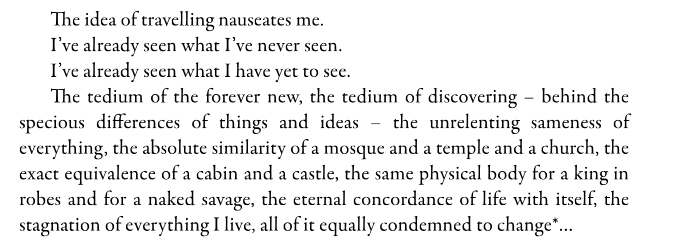
From “The Book of Disquiet, page 122”
“Am I losing anything by freeing myself of the curse of change?” should instead be the question, for lately, I more and more see my way as the rational and only way - the right way.
What I gain is control and freedom from anxiety ( as much as possible ) while the standing offer is uncertainty and no guarantee of a better experience. A satisfaction with the current status quo shouldn’t be an error in reasoning after all. There had been uneasiness in coming to this conclusion for others can’t see and accept this same way of life - but do they really matter?
The world is wrong and I accept it. Perhaps the uneasiness simply stems from the defiance of social expectations, for after all, I’ve never found someone quite as myself, but that isn’t any cause for change as long as I can address the most obvious question of it all.
What is the cost of the unlived life?
The only fear I have is that passage of time may one day bring me regret as to “what could’ve been” - to think that all I did all these years was fool myself. A certain vision, recurrent whenever I think about this, is me on my deathbed, old and fragile, wondering what tres leches taste like or if the stars and seas were truly as beautiful as everyone said. They don’t mean much, but what did I even forsake them for? That didn’t mean much either.
If right at this instant I were to make a choice to be different and reduce a part of that unlived life, I would make no choice at all, for it’ll be a present action, accompanied by anxieties of the present and all the other burdens as bells and whistles. But what about the past? It’s always easy to look at the past as an independent observer, for it’s just as if I were looking at someone else’s.
As for my past, I don’t think I regret this at all. Not going on any trip with so called “friends” or even family, missing out on a rafting adventure, not going to my convocation, not keeping in touch with friends, trying out more foods, even visiting more places within the city, none of those are a cause of regret to me. For I see them as worthless today, under the lens of no anxiety, as my past self would’ve seen it then. For things that truly mattered to me, I’ve been able to overcome my reluctance to change - it always took some effort but there is no self-deception there. What I’m not willing to change are purely things that I don’t believe are wrong, no matter how much someone else considers it to be so.
Would I really have no regrest with such a life? Would I really not change anything about my past - is that my implication here? No, if I could, I would definitely change a lot but not for the reasons that the this essay partakes in. I wish I would’ve not wasted as much time as I did - defnitely not on the things I wasted it on. I wish I had more discipline to work for things that I cared about and had more courage to refuse for things that didn’t. I wish I had treated human interactions as another system to be mastered instead of discarding it’s worth altogether. I wish I would’ve been more creative. I wish I had not neglected my health as much as I did and tried to eat healthier.
And for such infinite regrets, none of them are concerned with the world and what it had to offer - rather more so with how I could’ve taken more from the world now that I’ve written them down. For a very long time I considered this to be a “sickness”, but all that I earnestly wished for is control - to live how I want to - quite an innocent wish the products of which this world can’t understand, and it doesn’t need to. In the end, I think I can close this question, once and for all and with certainty. In the end, it doesn’t really matter if the stars I find so beautiful are real or a figment of my imagination as long as they are just as beautiful as I would’ve wanted them to be, which I can as long as I’m the one in control, which I can as long as I decided them to be so.